NIKE

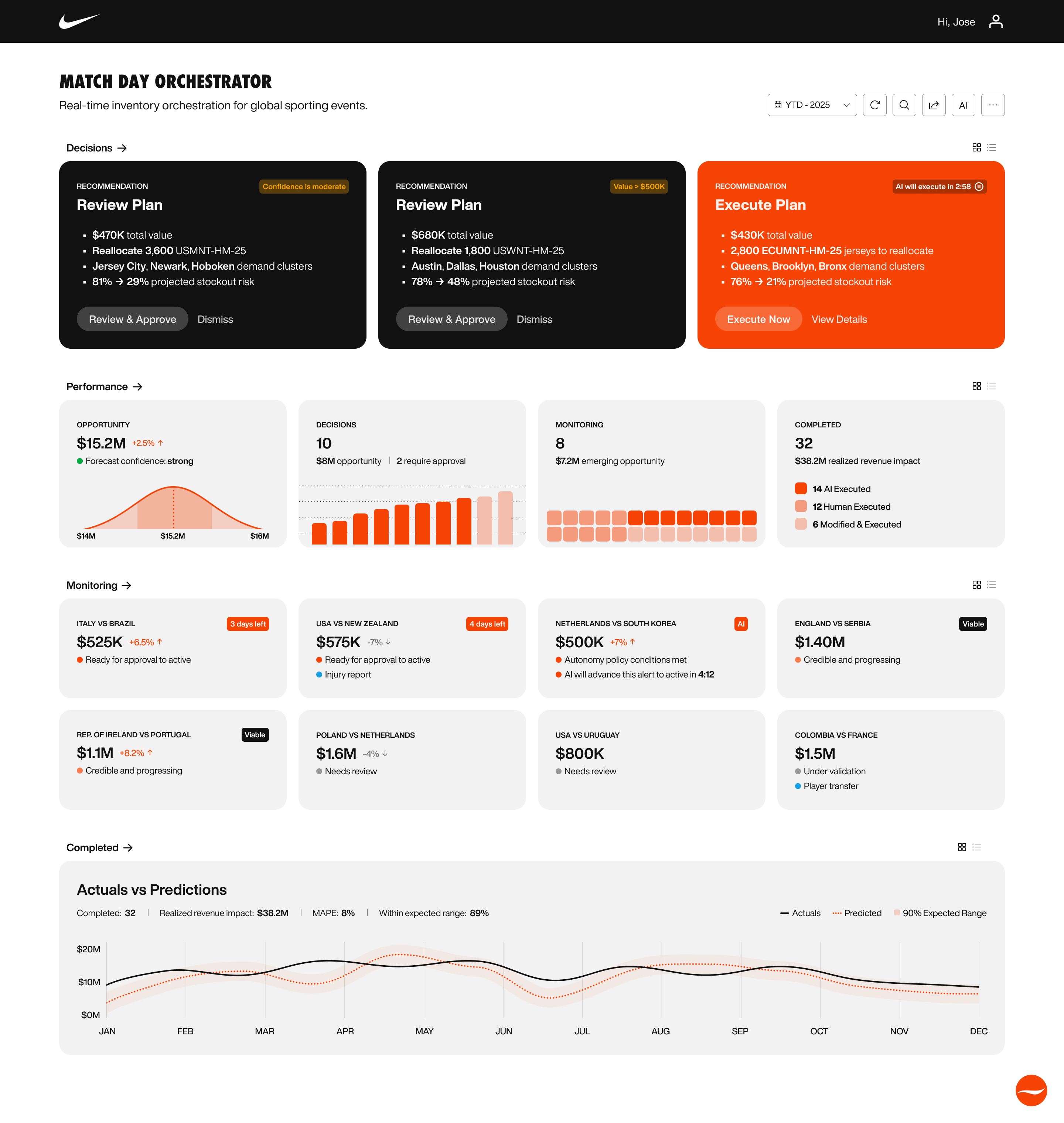
I was asked to take an initial AI-generated concept and turn it into a realistic 0→1 product vision for Nike's Match Day Orchestrator, an agentic AI system that helps supply chain and planning teams forecast demand, protect revenue, and coordinate real-time inventory decisions for global sporting events. The opportunity went beyond designing an AI experience. It required defining how probabilistic intelligence should participate in decision-making, when it should act, and when humans should keep control.
AGENTIC ORCHESTRATION
AI PRODUCT DESIGN LEAD
ACCENTURE / NIKE
2026
The genuine 0→ 1 opportunity was transforming an AI-generated intelligence workflow into a credible human–AI operating model.
From 0→1
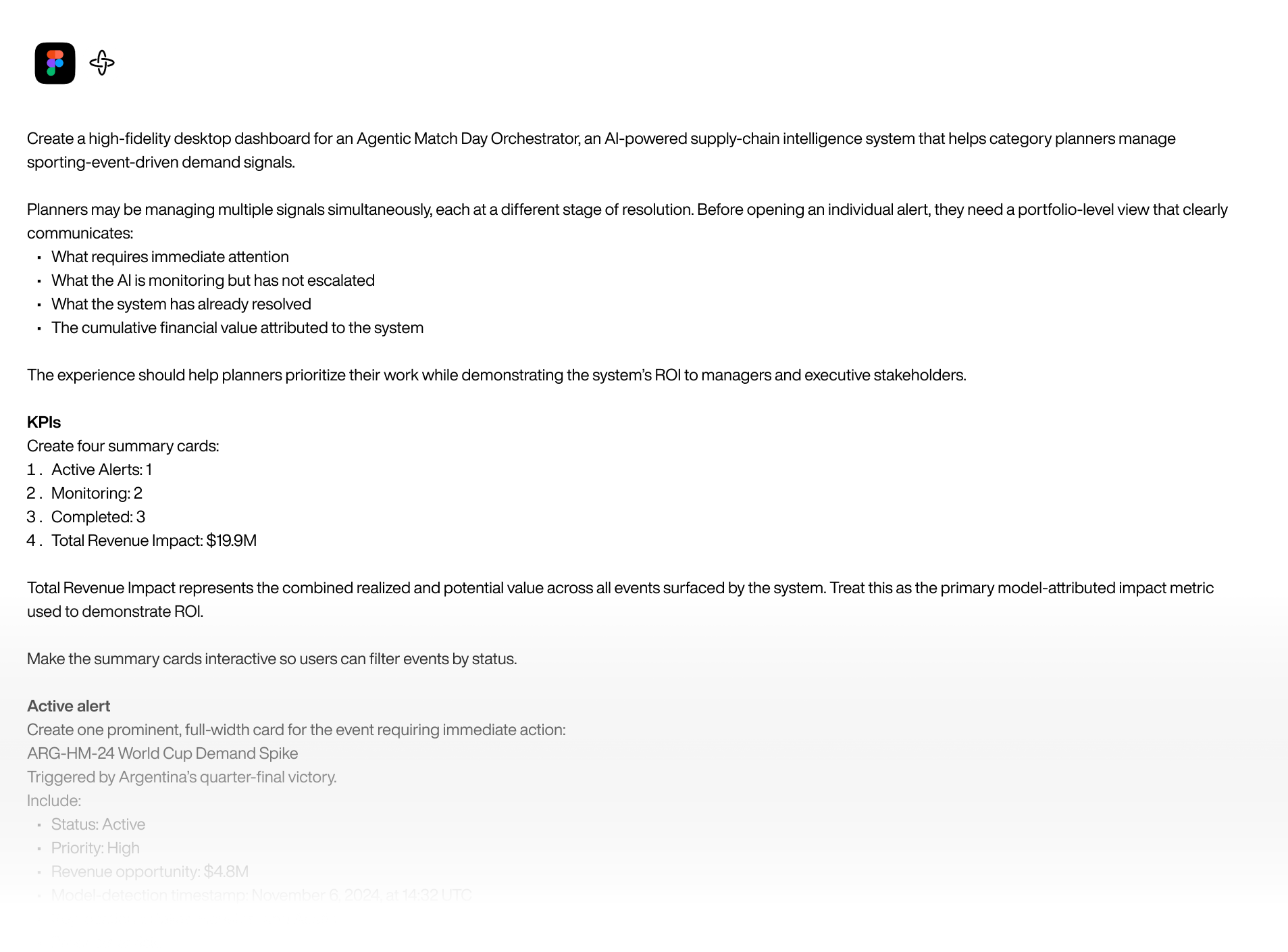
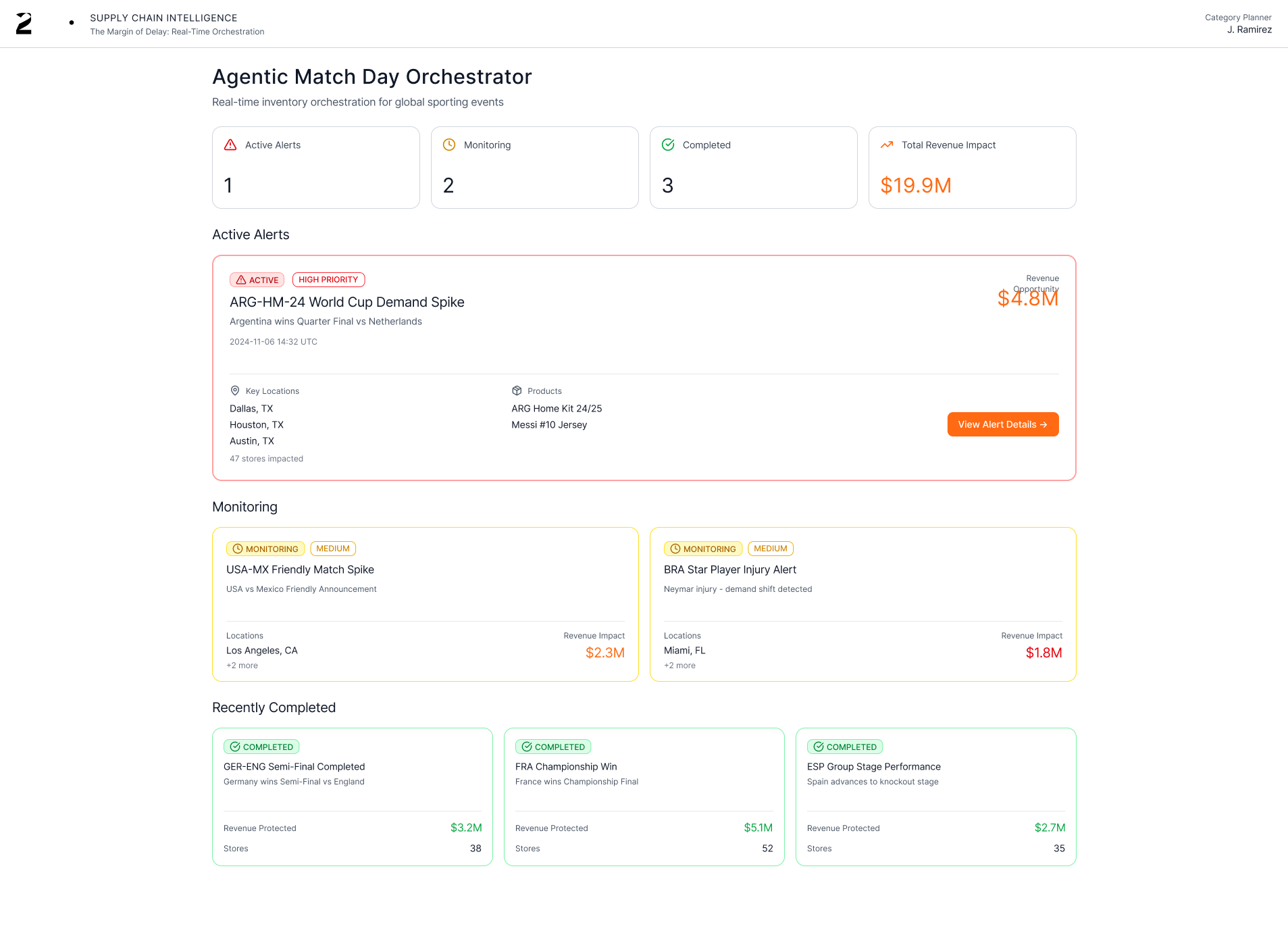
I didn't start with a blank canvas. Product owners and data scientists had previously used generative AI to make the underlying intelligence model tangible. Although these early ideas showed what the system could know, they didn't show how a human should interact with that intelligence.
The challenge wasn't just making AI usable, but making sure people could use it safely, repeatedly, and trust it over time.
AI Without Decision Architecture
Early concepts demonstrated that AI could detect signals, forecast demand, and recommend actions. But they left the most consequential questions about decision rights, autonomy, uncertainty, explainability, and human override unresolved.
The vision was not full automation, but the right amount of autonomy.
Designing for Earned Autonomy
The vision was to design a human-centered, agentic AI experience that converts real-world signals into actionable demand intelligence and gradually gains autonomy based on confidence, consequence, transparency, and human control.
The approach for designing the human-AI relationship evolved around four interconnected principles.
I designed a human-AI operating model that created friction. The intent wasn’t to slow down decision-making, but to slow it precisely where being wrong becomes expensive.
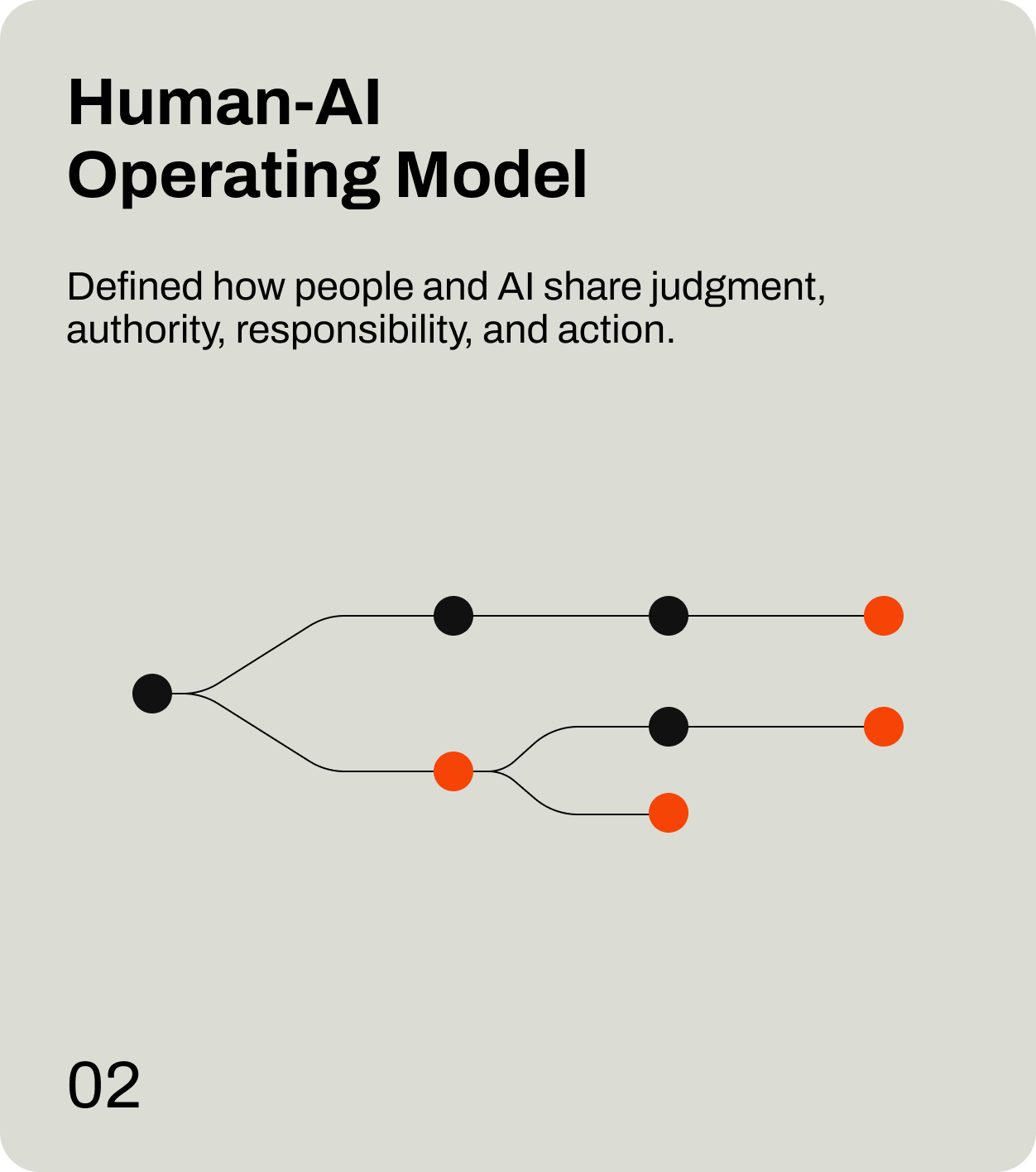
Designing The Human–AI Operating Model
The Match Day Orchestrator flow connected the full journey from signal detection to execution.This AI decision-to-execution orchestration loop accounted for only half of the overall experience. What was missing was a human-AI operating model, one that will define how people work with that intelligence and avoid probabilistic estimates being perceived as facts.
ADDING THE HUMAN Loop
The human layer I added to define how people work with AI intelligence was a decision flow. This dual-layer model turned a traditional forecasting workflow into a human–AI decision architecture in which humans have a meaningful cognitive role throughout the workflow, including approval mechanisms.
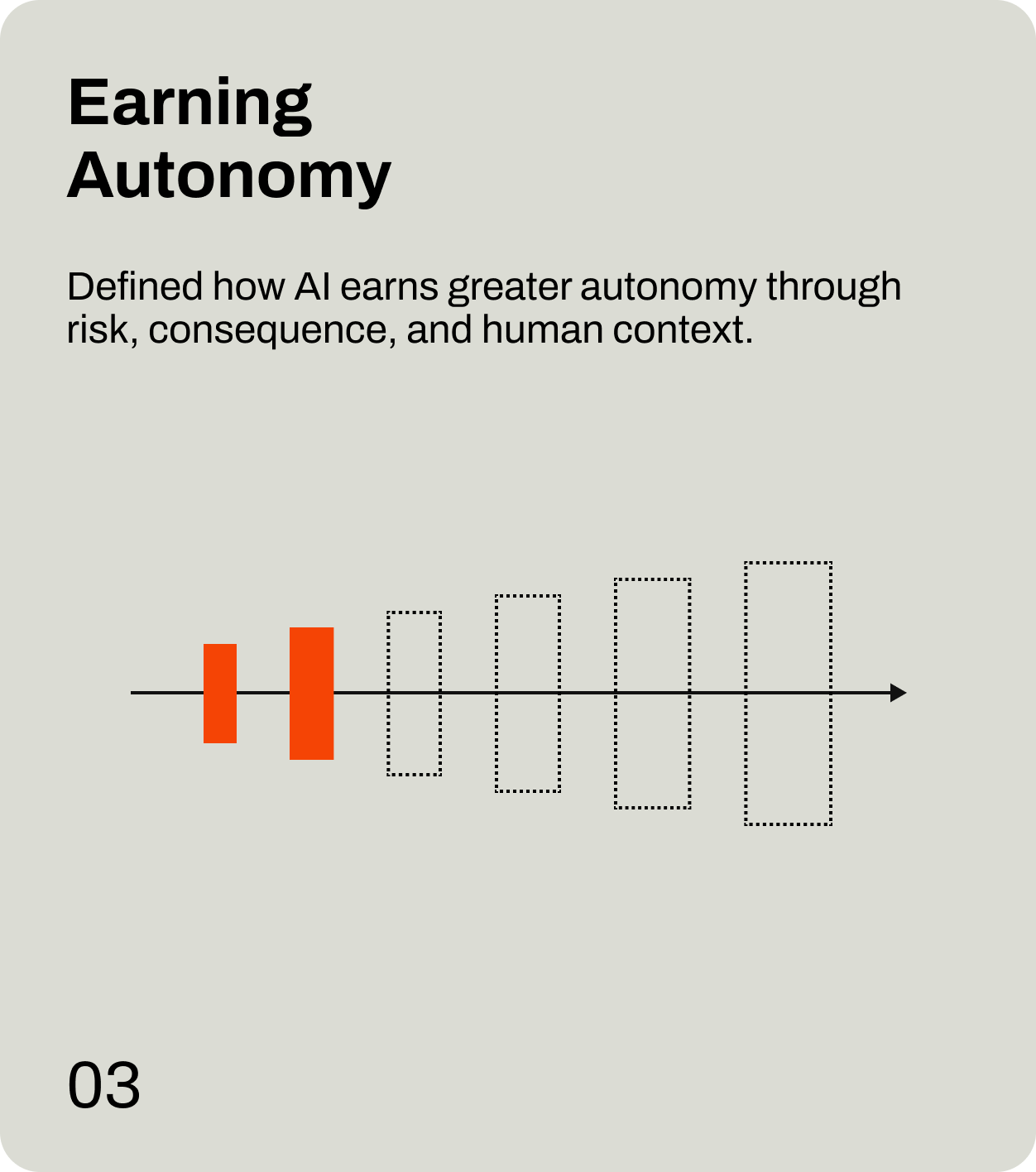
Autonomy was earned, not assumed, with greater agency granted only as the system demonstrated reliable performance over time.
AUTONOMY SPECTRUM
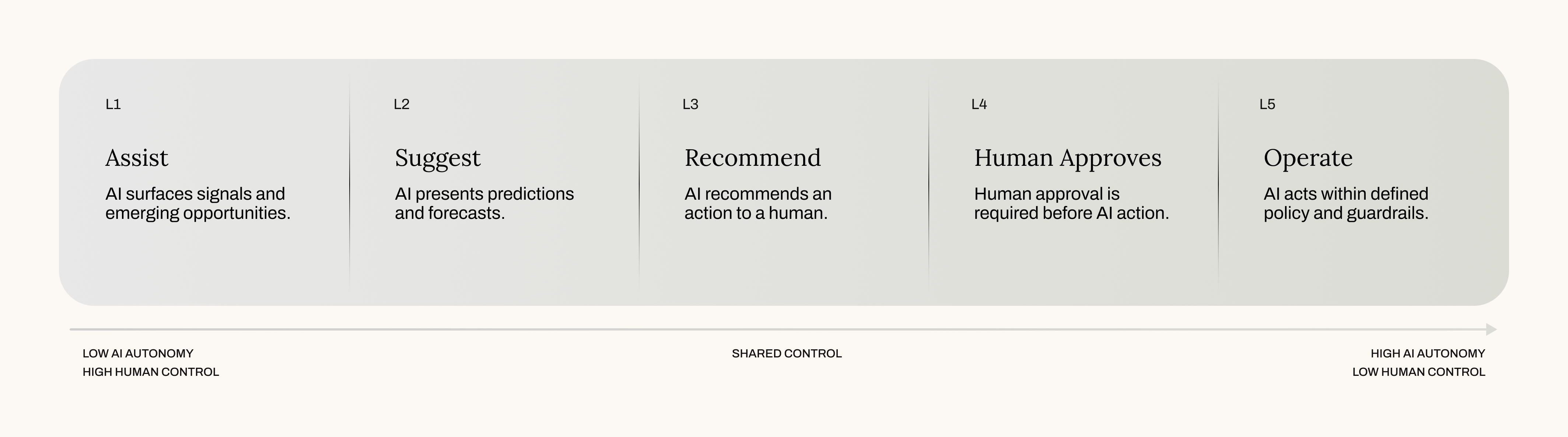
A key part of my human–AI operating model was defining how the system earns autonomy over time. The AI can assist, suggest, recommend, execute with human approval, or operate autonomously within defined guardrails. This autonomy spectrum maps a progressive shift from high human control to high AI autonomy.
Defining the Boundaries of Autonomy
The autonomy condition created a matrix that served as guardrails around the intelligence. The system could move faster where risk was low while preserving deliberate human control where judgment mattered most, and as the system improved, it earned more autonomy through demonstrated reliability.
L4 L1 L5 L2–L3 Execute with Human Approval Assist Operate Suggest and Recommend Human approval is required before AI action. AI surfaces signals and emerging opportunities. AI recommends and earns autonomy through policy. AI presents forecasts and recommends actions. HIGH CONSEQUENCE LOW CONSEQUENCE LOW RISK HIGH RISK
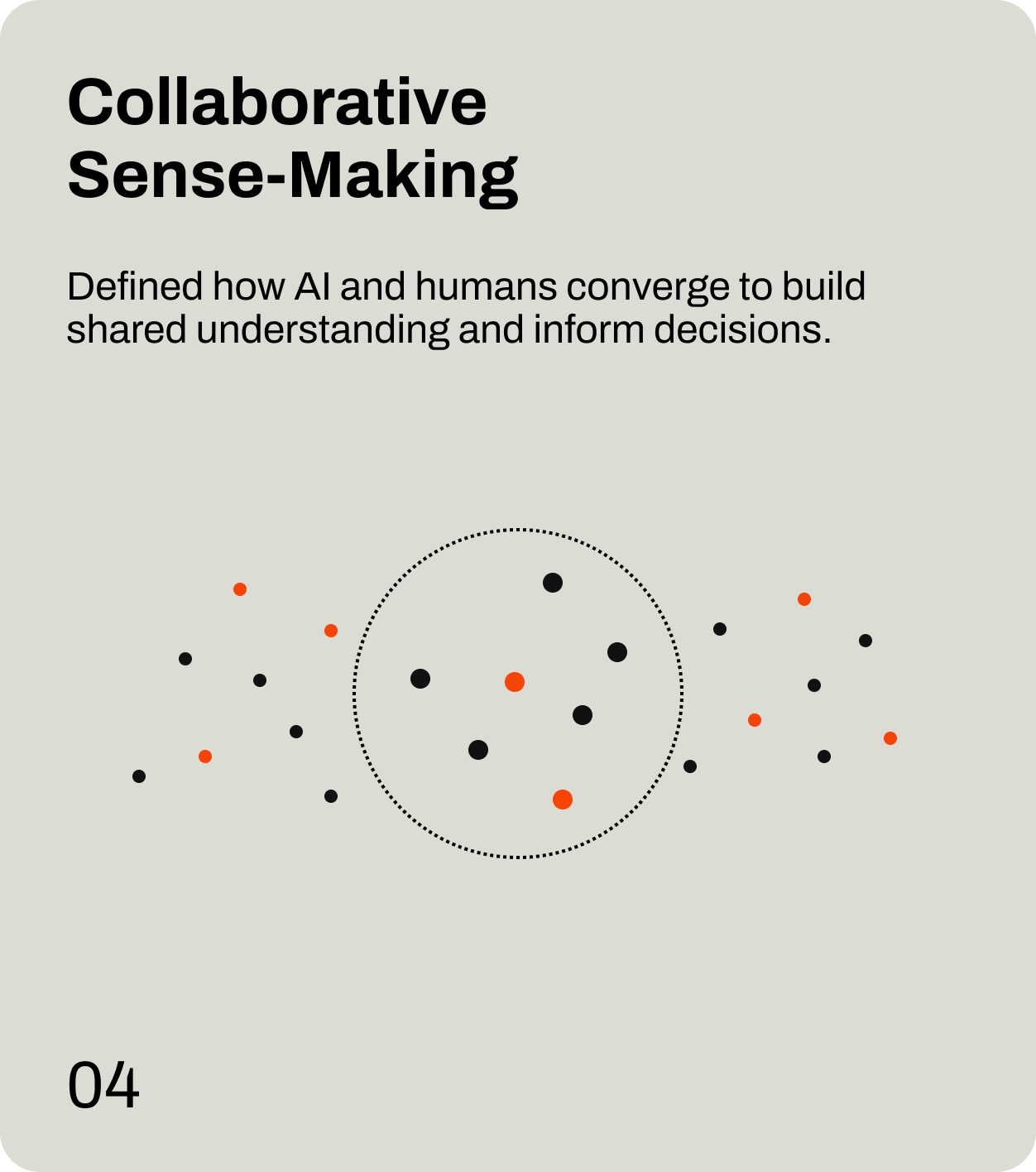
In collaborative sense-making, the objective is not to expose every signal, reasoning step, or other decision-support elements. It’s about finding the right balance of information since, under time pressure, too much explanation can create as much friction as too little.
A SHARED UNDERSTANDING
The experience surfaces the most decision-relevant evidence first and allows deeper investigation through progressive disclosure. The planner then contributes operational knowledge, context, skepticism, and judgment. Together, they establish a shared understanding of what is happening, why it matters, and what should happen next.
AI Signals • Event signals • Market signals • Demand signals • Inventory and revenue signals • Confidence and uncertainty signals • Operational constraint signals Shared Situational Awareness • Real world experience • Context • Skepticism • Judgement • Intent Human Operational Knowledge
Managing trust via transparent experiences that provide visibility, explainability, and user control.
Clarity first, depth when needed
Planners can assess critical insights at a glance, then explore forecasts, uncertainty, and supporting evidence when they need deeper context to make an informed decision.
INTELLIGENT DISCOVERY FRAMEWORK
I designed a reusable progressive-disclosure discovery layer that presents additional contextual evidence, explanations, and supporting intelligence as an on-demand slide-out panel, without disrupting the main experience.
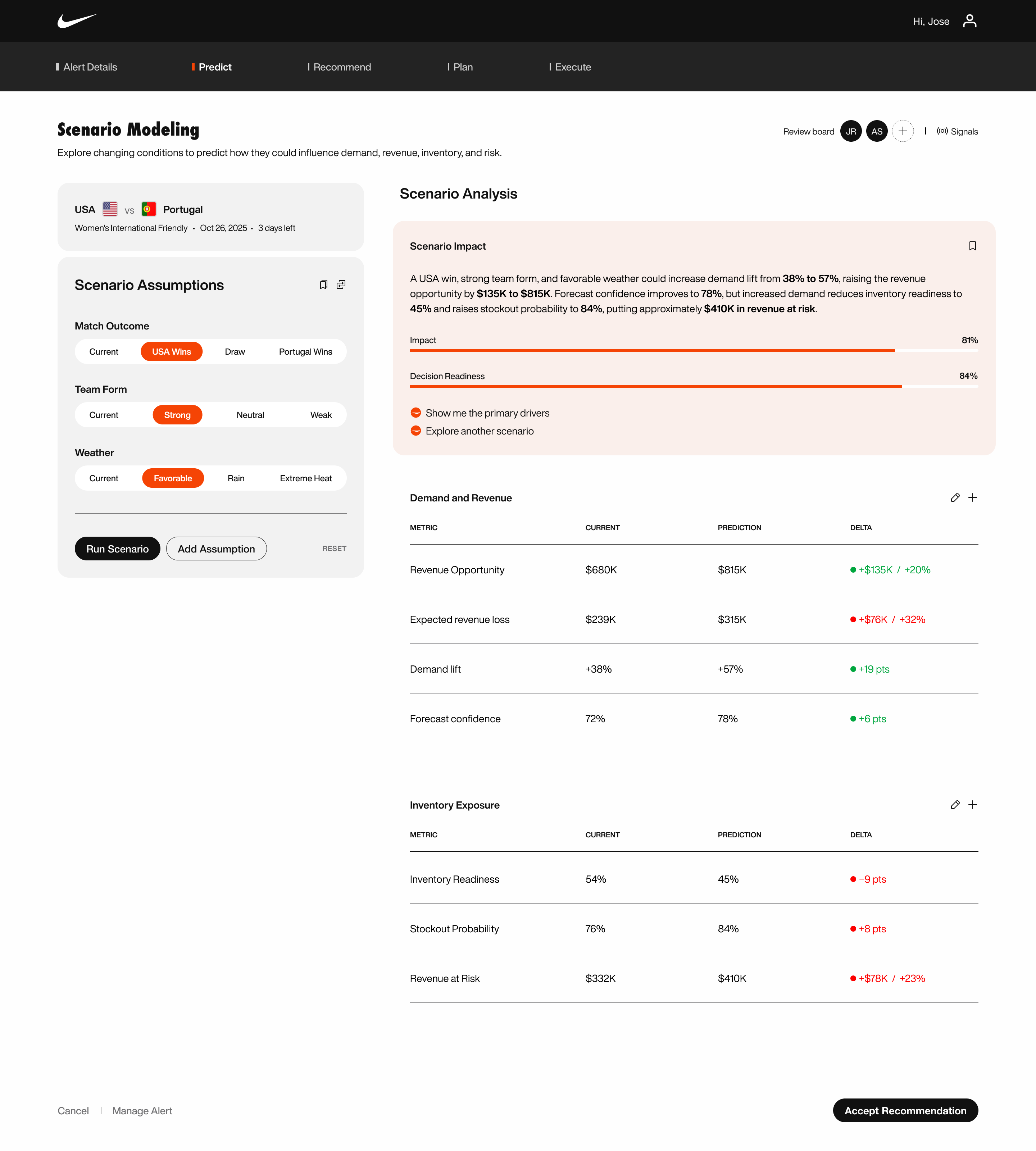
I designed scenario modeling to make uncertainty actionable and help planners distinguish predictions from facts.
SCENARIO MODELING
I designed an interaction model that lets planners test assumptions and explore how changing conditions affect forecast outcomes, uncover trade-offs, and prevent predictions from being mistaken for certainties.
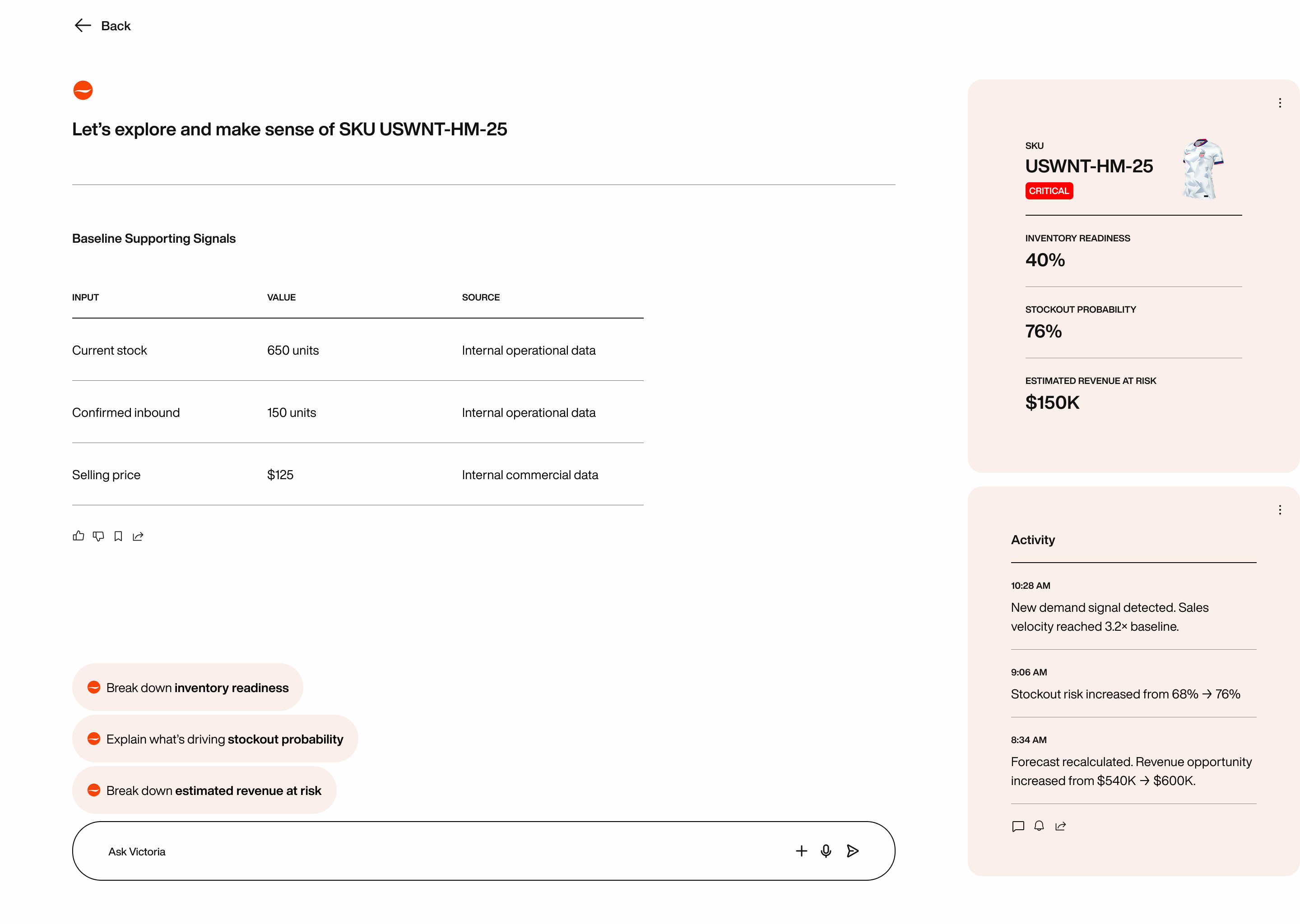
I created Victoria to support collaborative sensemaking by integrating AI intelligence, operational context, and human judgment in a shared conversation.
VICTORIA
I designed a conversational experience supported by contextual suggestion chips throughout the product. Victoria combines AI-generated insights with structured operational data, allowing planners to question predictions, explore evidence, and apply their own judgment during decision-making.
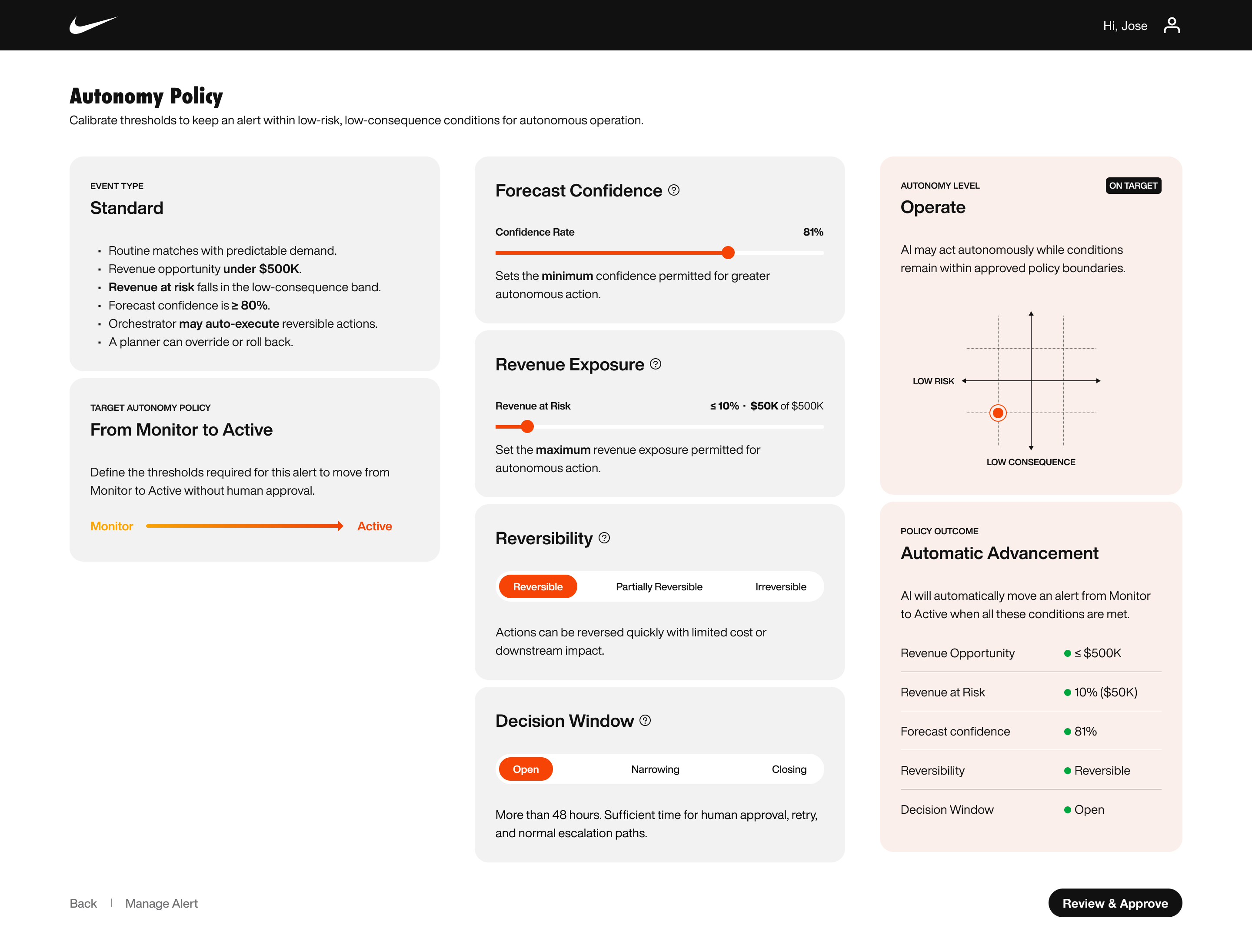
I designed governance controls that make AI autonomy conditional, keeping autonomous execution within human-defined boundaries.
AUTONOMY POLICY
I designed administrative calibration features that allow authorized users to set autonomy thresholds. These policies define the boundaries for autonomous execution, required human approval, or blocking execution.
CALIBRATING AI AUTONOMY
Adjust thresholds to explore how risk and consequence shape AI autonomy and reach L5 Operate.

Forecast Confidence

81%

Sets the minimum confidence permitted for greater autonomous action.

Revenue Exposure

≤ 10% · $50K of $500K

Set the maximum revenue exposure permitted for autonomous action.

AUTONOMY LEVEL AI Operates
ON TARGET
HIGH CONSEQUENCE LOW CONSEQUENCE LOW RISK HIGH RISK

Forecast Confidence

81%

Sets the minimum confidence permitted for greater autonomous action.

Revenue Exposure

≤ 10% · $50K of $500K

Set the maximum revenue exposure permitted for autonomous action.

AUTONOMY LEVEL AI Operates
ON TARGET
HIGH CONSEQUENCE LOW CONSEQUENCE LOW RISK HIGH RISK
I translated an agentic AI concept into a concrete product vision that supports supply chain decisions.
IMPACT
For an Accenture sales pursuit supporting a funded Nike initiative, I built a high-fidelity prototype showing how AI unifies demand signals, probabilistic forecasts, scenario modeling, and inventory execution in a single decision-to-execution workflow.

This concept gave Nike and Accenture stakeholders a joint vision for planners collaborating with autonomous intelligence, while continuing meaningful human control beyond a simple approval step.

This work resulted in a product direction grounded in business needs, making autonomy, explainability, and accountability central to the user experience.